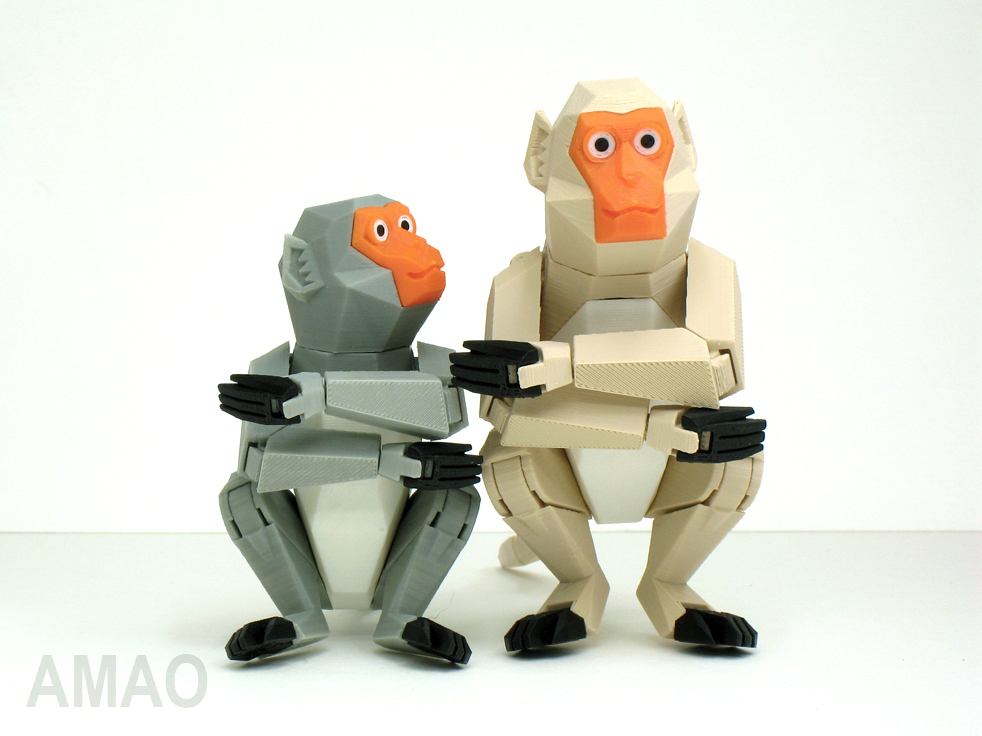
About this 3D model
Summary Bing-shen year of Formosan macaques In Chinese Zodiac, the year of the Monkey is in Feb. 8, 2016-Jan. 27, 2017. I designed Bing-shen year of Formosan macaques to celebrate the coming of a new year, and I hope to use this opportunity to draw attention for Formosan macaques in Taiwan. Formosan macaques, Macaca cyclopis, have been inhabiting in Mountain Shou-shan in Taiwan for many years. In recent years, tourists or local residents involving in feeding macaques have been raising a controversial issue. The foraging behavior of these macaques have been changing, and the macaques have becoming dependent upon handouts increasingly. In addition, the intense monkey-human conflict have been occurred. Some of macaques snatched the food from tourists, and some even invaded into local houses. In response to these threat, the tourists or local residents around villages started to attack macaques. Some of macaques were found being poisoned and attacked by human as their body appeared with wounds. The conflict around villages were intense against the species and its protected status. Scientists reported that 200 of the species were missing. These were the worst environment for Formosan macaques habitation. Scientists started working on conservation measures to reduce the conflict, they tried to provide a less disturbed habitats for macaques. They suggested the best way to resolve the conflict is to stop feeding, disturbing and touching macaques, so that macaques can stop dependent on human and start back to their habitats. As I designed Bing-shen year of Formosan macaques, I tried to left an imprint of time on their body. Thus, the foot of Bing-shen year of Formosan macaques are imprinted with Chinese words of Bing-shen. Chinese sexagenary cycle is a means of recording days or years. Most of people believe that the year of the Monkey will be back in the period of 12 years. In fact, the same year of the Monkey will be back in a circulation of 60 years, that is, it takes 60 years to wait for the next the year of Bing-shen of the Monkey. I designed 24 of nodes on macaques’ body, and each of nodes are rotatable and adjustable, which permits the macaques to show variable dynamics and expressions. Each of rotatable nodes are representing each of 24 solar terms, climate changes of weather in a year, in Chinese Lunar calendar. As a full circulation of 24 solar terms completed, that means a new year is coming again. I looked forward this design of Bing-shen year of Formosan macaques would remind ourselves of precious time and hopes we can use the time in a meaningful way. PS. If the one piece model of monkey tail is not easy to bend, we suggest to print the composed tail model. Don't printing all models are small then 86% of original model size, and set up 0.15mm layer resolution. Design Software - SketchUp my settings ABS support angle 30 deg z resolution 0.2mm scale 100% https://www.facebook.com/paperworkers https://amaochan.work/work/ https://www.youtube.com/watch?v=1MdAZr_GWi8 Bing-shen Year Formosan Macaque February 8, 2016 to January 27, 2017 was the Year of the Monkey in the Chinese world, so I designed the Bing-shen Year Formosan Macaque to celebrate the coming of a new year, and I hope to use this opportunity to draw attention to the tense relationship between macaques and humans in Taiwan. The wild Formosan macaque population living on Shou-shan Mountain in Kaohsiung has changed its natural foraging habits due to long-term human feeding. As macaques began to regard humans as one of their food sources, human-macaque conflicts have occurred. Some macaques snatch food from passersby and invade homes to steal food. Residents, bothered by this, have allegedly retaliated and harmed these macaques; multiple suspected cases of macaque poisoning have been reported, and some macaques even have obvious human-inflicted wounds. Experts say over 200 macaques have gone missing. This represents the worst state of human-nature coexistence. Biologists suggest the best way to resolve the conflict is to stop feeding the macaques, refrain from bringing food up the mountain, and avoid disturbing or touching them, allowing the macaques to stop relying on humans and eventually return to their wild habitats. When designing the Bing-shen Year Formosan Macaque, I wanted to mark the passage of time on its body, so I inscribed the characters "Bing-shen" on its feet. The Heavenly Stems and Earthly Branches are an ancient Chinese method for recording time. Most people believe the Year of the Monkey returns every 12 years; however, the exact same Year of the Monkey (Bing-shen) only cycles back after 60 years. This means a newborn this year will be 60 years old when the next Bing-shen Year comes around. I designed 24 rotatable nodes on the macaque's body. Adjusting each node affects the overall posture and expression, which represents the 24 traditional lunar solar terms. Each solar term marks a minor shift in climate throughout the year, like d