About this 3D model
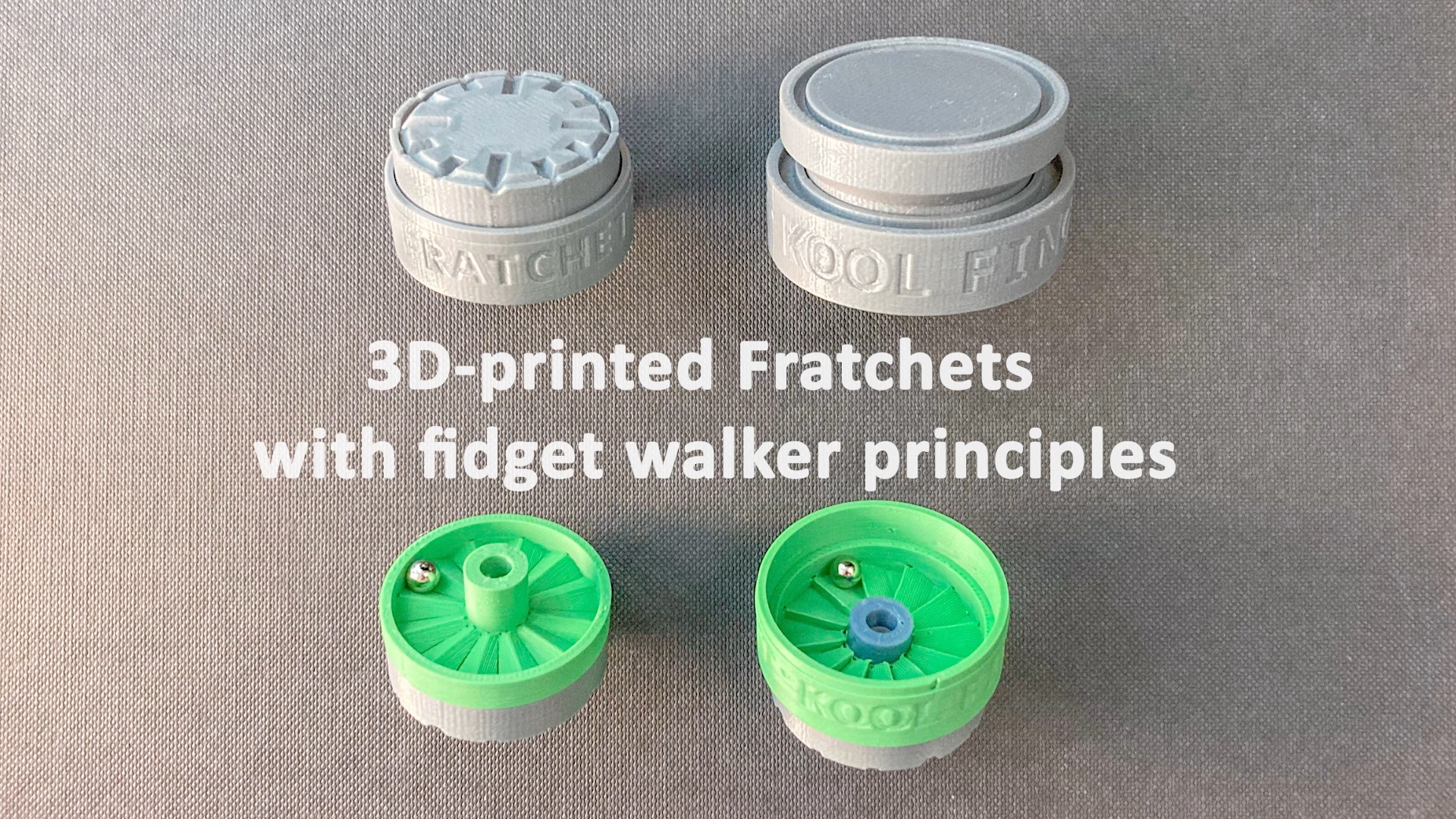
Name: Fratchet Coins & Knobs: magnetic ratchets without springs Video: https://youtu.be/LA6X_rGLK14 Printing Instructions: https://koolfingers.com/3d-prints/printing-fratchets/ Fratchets are fidget ratchets without mechanical springs. Instead they are powered by magnets. But they do feel and sound like socket wrenches, cog rattle, and ratchet strap buckles. Despite their sophisticated sound and haptic feedback, they are quite simple: a bunch of 3d-printed parts snapped together to capture magnets inside them. Some very smart people say you can't make fidgets simpler than these. We came up with these, and hold pending patents on the concept of fidget walkers - think "walking a magnet with another magnet over a largely uneven surface". You can print fratchet coins and knobs for personal use. Feel free to build on them as well for non-commercial uses. They go under CC BY-NC-SA 4.0 as detailed at https://koolfingers.com/3d-prints/. More on licensing later. This package contains STL parts for a thumb coin you can roll with just a thumb, and a hand knob that you can grip and operate with multiple fingers. Each fratchet consists of a dial and a base. The coin dial comes with a standard base, and the knob dial a large base. But the coin dial can be used with either side of the large base, for altered ratcheting feedback. And either side of the knob dial works with either side of the standard base. There are also 3MF files for slicer apps we have used ourselves, which you may find useful. MAGNETS REQUIRED FOR FRATCHETS Each dial has embedded in it one or more disc magnets. The disc magnet needs to be of specific dimensions to fit a magnet holder inside the dial. Each base encloses a moving ball magnet inside its base body. Any magnet that fits the base body can be used as the inside magnet. The shape, the size and the magnetic strength of the inside magnet affect tactile and acoustic feedback. DIAL MAGNET: one or more 6mm x 3mm N35 neodymium disc magnets. Most disc magnets found online actually measure 6mm x 2.67mm - these are usable too. Many disc magnets are sold without explicit specs for their strength. Most of these are N35. INSIDE MAGNET: We recommend a 5mm N35 neodymium ball magnet as the inside magnet. For most PLA prints, this produces a deep bass sound and a satisfactory haptic experience. These are the original Buckyballs, and are no longer easily found online. But you will likely not find exact 5mm magnets. Many magnets sold under the "5mm-diameter" label are actually 3/6" (4.76mm) ball magnets - they are weaker. But if that's all you've got, then use them. You may also pop in a 1/4" (6.3mm) N52 neodymium ball magnet instead. These make turning the dial harder, in our opinion. But perhaps you will like it. You can also substitute ball magnets with disc magnets, and even cube magnets, for different types of fidget walker feedback. Fratchets on our Amazon store are furnished with the 6mmx3mm N35 neodymium disc magnet and the 5mm N35 neodymium ball magnet we recommend. You can purchase these fratchets at: https://www.amazon.com/koolfingers Warning: swallowed small magnets can stick together across intestines causing serious infections and death. Seek immediate medical attention if magnets are swallowed or inhaled. SUGGESTED PRINT SETTINGS: Always go to our Kool Fingers website for the most up-to-date printing instructions. And remember that there are readme files next to 3MF files for common slicer apps. These fratchet models have been designed with very specific fit tolerance, to make these pieces fit tightly but not much that you can't snap them together. Here are some general considerations: * Print with PLA. But they also work with PETG, ABS, etc. * They work best printed with 04mm nozzles * Use a 0.15mm layer print profile * Specifically, use a 0.2mm first layer height * and the a 0.15mm height for all subsequent layers * Top shell layers: 7 * Top shell thickness: 0.7 mm * Bottom shell layers: 0.5 * Bottom shell thickness: 0.5 mm * Detect thin walls: ON * Sparse infill density: 30% * Sparse infill pattern: Gyroid or Grid POST-PRINT PROCESSING: There is no need for post-print processing, except occasional cleaning of stray strings, and deburring of rugged edges and print defects. ASSEMBLING A FRATCHET: The "Thumb Coin" dial and the "Hand Knob" dial have different disc magnet arrangements. The coin dial only requires one disc magnet, and presents only one usable surface for "dialing" (or walking) the inside magnet in a base unit. The knob dial presents two usable surfaces, with 3 disc magnets captured inside, aligned along the same flux line. The orientation of the disc magnet in a coin dial is not important. You can place a magnet into the magnet holder with the North up or the South up. Once the magnet is in place, you place the top part on the bottom part, and align the sun ray lines on the top part with notches on the rim of the bottom part. Align long rays with deeper notches. Then you snap the top