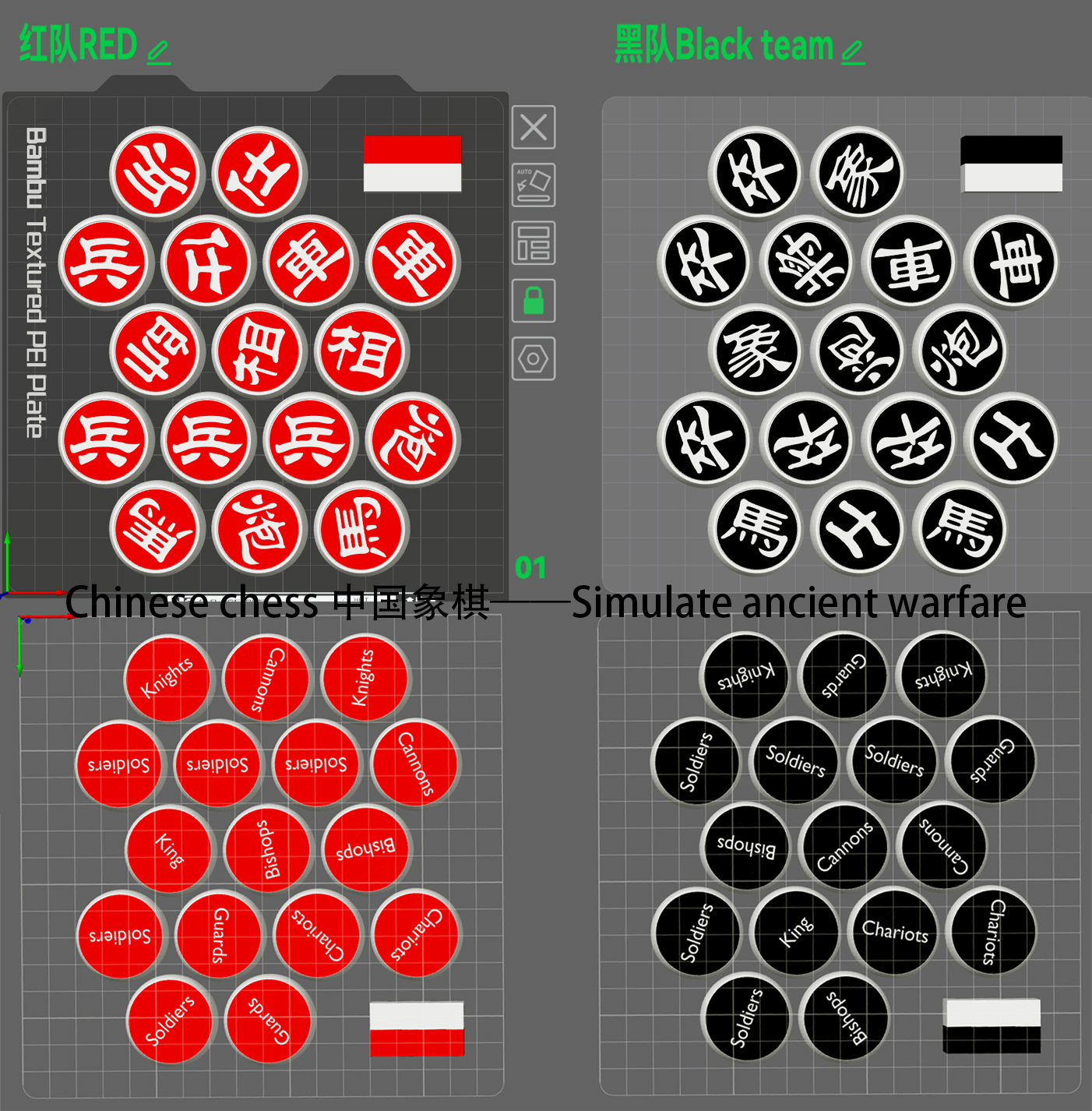
About this 3D model
Chinese chess, originating in China, is a two-player adversarial game with a rich history. Its simple equipment and engaging nature have made it a widely popular chess activity. Chinese chess is a cultural treasure of the Chinese nation, boasting a long history, captivating allure, and clear, straightforward rules. Its enduring popularity spans centuries. Chinese chess simulates ancient warfare, linear battles, land-based conflicts, and planar combat. In ancient China, chess was considered a self-cultivation art for scholars and officials. Nowadays, it is regarded as a wholesome activity that invigorates both the mind and body. Xiangqi integrates culture, science, art, and competition, not only stimulating intelligence, illuminating thought, honing dialectical analysis skills, and fostering tenacious resolve, but also cultivating the mind, refining emotions, and enriching cultural life. It is deeply cherished by the masses. The board can be drawn or carved by hand. Today, we will delve into the basic rules of Chinese chess and explore the expressions of Chinese and English terminology. Chinese chess中国象棋 Rooks (or chariots) 车 Knights (or horses) 马 Elephants (or bishops or ministers) 象/相 Mandarins (or advisors or assistants or guards) 士/仕 King (or generals) 将/帅 Cannons 炮 Pawns (or soldiers) 卒/兵 CXQ Chinese Chess Basic Rules中国象棋基本规则 One can move the pieces according to the following rules: Rules:行棋规则: The King moves only one space at a time, either horizontally or vertically. Moreover, the King must always remain within the palace, which is a square marked with an X. 将(帅):一次走一格,可以横向走,也可以纵向走,但不能离开九宫。 The Guards (Advisor) move only one space at a time diagonally. Similar to the King, the guards must remain within the palace. 士(仕):一次斜向走一格,和将(帅)相似,也不能离开九宫。 The Ministers (Elephants) move two spaces at a time diagonally (i.e. 2 spaces left/right and 2 spaces up/down in a move). They must remain on their own side of the river. If there is a piece midway between the original and final intended position of a minister, the minister is blocked and the move is not allowed. 象(相):一次斜向走两格(即向左或右横向走两格以后再向上或向下纵向走两格)。象(相)不能过河。如果象的原始位置与终点位置之间的中心点上有一颗棋子,则叫做塞象眼,这时象不能飞到目标点。 The Rooks (Cars) move one or more spaces horizontally or vertically provided that all positions between the original and final positions are empty. 车:走直线,可以横向或纵向走一格或多格,只要起始位置与终点位置之间没有其他棋子阻拦。 The Knights (Horses) move two spaces horizontally and one space vertically (or respectively 2 spaces vertically and one space horizontally). If there is a piece next to the horse in the horizontal (vertical) direction, the horse is blocked and the move is not allowed. 马:先横向走两格,再纵向走一格(或先纵向走两格,再横向走一格)。如果先走的两格里有一颗棋子紧挨着马,则叫做别马脚,这时马不能跳到目标点。 The Cannons move one or more spaces horizontally or vertically like a Rook. However, in a capture move, there must be exactly one non-empty space in between the original and final position. In a non-capture move, all spaces in between must be empty. 炮:和车一样,可以横向或纵向走一格或多格。但是,炮在吃对方棋子的时候,炮的起始位置与终点位置之间必须有一颗棋子。不吃子的时候,炮的起始位置与终点位置之间不能有棋子阻拦。 The Pawns (or Soldiers) move one space at a time. If a pawn does not cross the river yet, it can only move forward vertically. Once crossing the river, the pawn can also move horizontally. 兵(卒):一次走一格。兵(卒)在没有过河之前,每次只能向前走一格。过了河以后,兵(卒)除了可以向前走一格以外,还可以向左或向右横向走一格。 Capture: When a piece moves to a position currently held by an opponent's piece, it captures that opponent's piece. The captured piece is removed from the board. 吃子:棋子走动一步,如果结点上刚好有对方的一颗棋子,则可以吃掉对方的棋子。吃掉的棋子要从棋盘上拿走。 King's line of sight: The two Kings in the board must never be on the same file (vertical line) without any pieces in between them. A move that puts the two Kings in such a setting is illegal. 将(帅)对面:将和帅不能位于同一条纵向的直线上且将帅之间没有其他棋子而直接对面。如果一方行棋以后将帅直接对面了,则这步棋为不允许着法。 King safety: One must never leave the King to be captured by the opponent in the next move. Any moves that put the King in such a setting are illegal. 应将:当一方下一步可以吃掉对方的将(帅)时,象棋术语叫做“将军”。当一方被将军时必须应将,即不能让对方下一步棋吃掉己方的将(帅)。 End game condition: The game ends when one of the following situations happens: 终局:出现下列情况之一即结束棋局: Checkmate: If one threatens to capture the opponent's King and the opponent has no way to resolve the threat, one wins. 将死:如果第一方在将军,而对方无法解将,则第一方胜。 Stalemate: If one does not have any valid move, one loses. 困毙:当一方无子可走,则困毙输棋。 Terminology: To make the rules precise, the following terms are used: 象棋术语: Check: A move of any piece that causes the opponent's King to be threatened with capture in the next move. 将军:一方下一步即要吃掉对方的将(帅)。 Same type sacrifice/trade: A piece moves to a position where it can capture an opponent's piece of the same type in such a way that the opponent piece can also capture it in the next move. 兑子:一方走一步棋后可以吃对方相同的一颗棋子,而对方下一着也可以吃掉这颗棋子。 Chase: A piece moves to a position where it can capture an opponent's piece, which is not the King, in the next move. It is also a chase when a piece moves and results in a cannon attacking an opponent's piece. There are a few exceptions: 捉:一方行