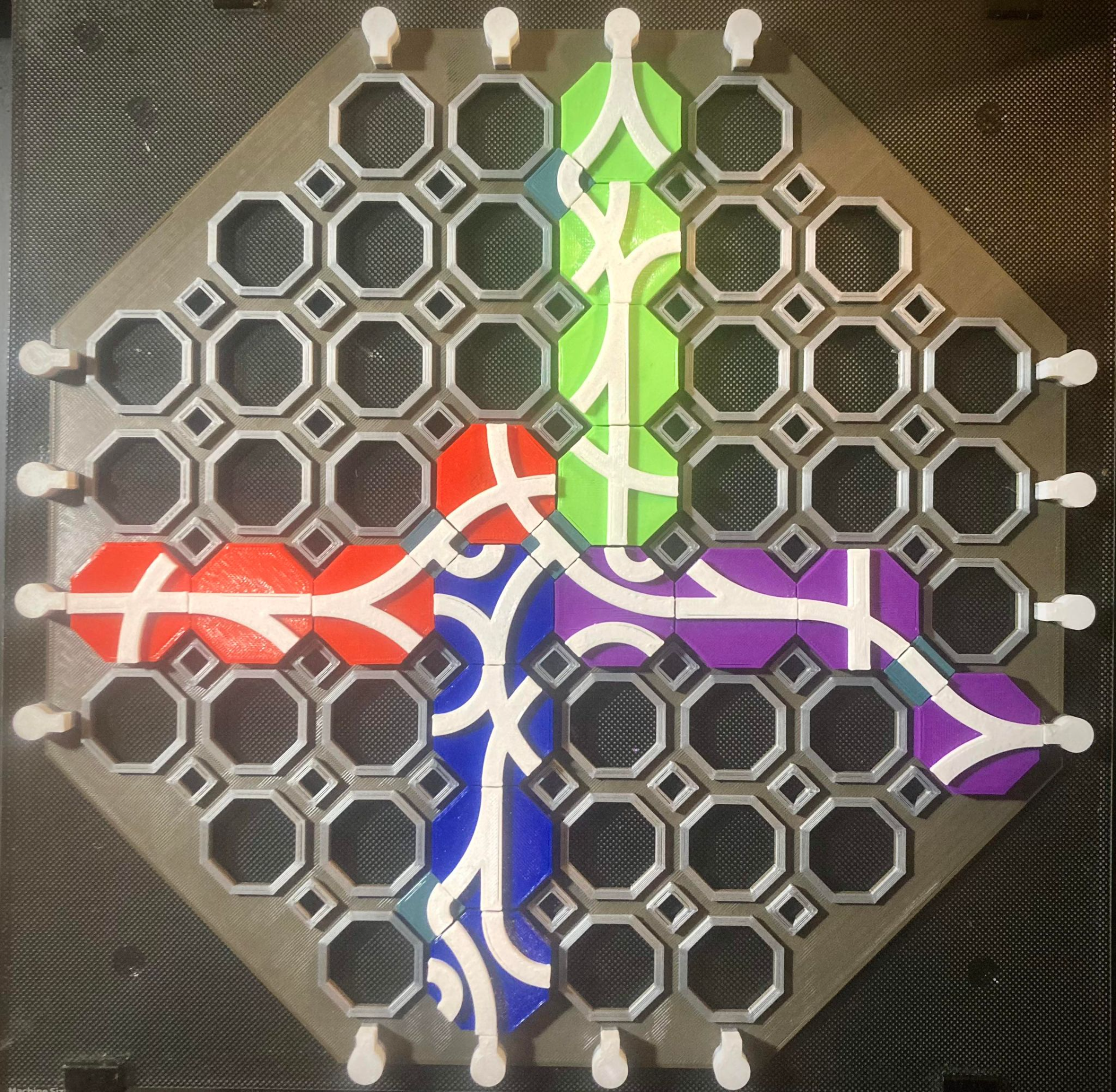
About this 3D model
PRINTING NOTES: Our Crosstrack Standard Board is 293x293mm - Printed on 300x300mm bed. Our Crosstrack Challenge Board is 235x235mm - Printed on a 300x300mm bed. We tested reduced sizes down to 70% (205x205mm for Crosstrack Standard Board) @ .3mm layer height and the parts were still playable. This is great news for anyone with a smaller build! It may be sugguested to lower layer quality to .2mm along reducing the size to 70% for the best fitting game peices. No supports are needed (Thanks, Geometry!) 3mm layer height should work just fine! May have to turn off "skirt" at 100% scale - A layer/color change at “layer 31” will allow for you to customize your base and track colors. White is sugguested for the track color - but you're encouraged to make the board and game peices your own colors ! at 100% scale - A color change at layers 9 and 16 on the Crosstrack Standard Board will result in a unique 3 color gameboard! at 100% scale - A color change at layers 9, 16, 31 on the Crosstrack Challenge Board will result in a unique 4 color gameboard! Have Fun - This is one of my favorite board games and I'm excited to bring it to the community! ABOUT THE GAME AND THE RULES Crosstrack - A Unique Track Switching Game Players place special track pieces onto an irregular octagon board, winning by being the first to create an unbroken path between two opposite sides. Players 2-4 Setup time 30 seconds Playing time 10-30 minutes Chance None Age range 8+ Skills Tactics, Strategy Crosstrack Standard Board Played on an octagonal board with 52 octagonal cells and 45 square interstitial spaces, arranged in a 4×3 configuration, with four paths leading inward along each of the 4-cell sides. There are 32 octagonal pathway pieces and 16 square intersection pieces with raised tracks; the 32 octagonal pathway pieces are divided evenly into 4 color sets, each with 8 pathway pieces, and the 16 square intersection pieces are a single color (black). Each of the eight octagonal pathway pieces in a color set have unique patterns, and each of the four color sets have the same set of eight patterns. Four of the octagonal pathway pieces in each set have two paths linking three or four sides, and the other four have three paths linking five or six sides. The square intersection pieces are divided evenly into four each of straight, crossed, tee, and elbow paths. Crosstrack Challenge Board Challenge is a travel variant with a smaller 4×2 octagonal board and 32 octagonal cells. Unlike the Standard variant, Challenge has the 25 interstitial square cells prepopulated with connectors and there are no intersection pieces. There are 24 octagonal pathway pieces supplied, in 4 sets of 6. Like the Crosstrack Standard , within each color set there are six unique patterns; each color set has the same six unique patterns, that is, there are four pathway pieces with a given path/track pattern, one in each set color. Three of the eight octagonal pathway pieces from Crosstrack Standard have been removed, leaving five of the six pieces the same as the larger game; one pathway piece with two straight, crossed paths has been added: Rules: Setup Players choose one color and take all the octagonal pathway pieces in that color as their "stock"; depending on the number of players, players may be required to choose more than one color. In the Standard Version, the square intersection pieces are left in a common pile (16 pieces). Play starts with the youngest player and proceeds to the left. During the opening round of moves, each player must place one pathway piece on any open cell in the board; intersection piece placement is not allowed until each player has played one pathway piece. All games Play begins with an empty board and the octagonal pathway pieces are distributed amongst the players as their playing stock. To win, a player must connect any two opposite sides of the board in an unbroken path, regardless of the colors of the pathway pieces used for that path. Each player's turn consists of one of three basic moves: Place an octagonal pathway piece from their own stock onto any unoccupied spot on the board. Rotate a pathway piece already on the board to any chosen orientation, if they placed it there. Move one of their pathway pieces already present on the board to any unoccupied space in any orientation. For the Standard Version board, any player may place a square intersection piece during their turn, following the opening round of moves. Once played, a pathway piece remains on the board; it may be moved or rotated by the player who placed it (or, in the team variant, by the player's teammate). During their turn, a player also is not allowed to rotate or move any piece played by an opponent. In addition, a placed piece cannot be removed or replaced with another one from the player's stock. The rotate and move are mutually exclusive: if a piece is rotated, it cannot also be moved to a different spot on the board. Likewise, if the piece is moved, it cannot also