About this 3D model
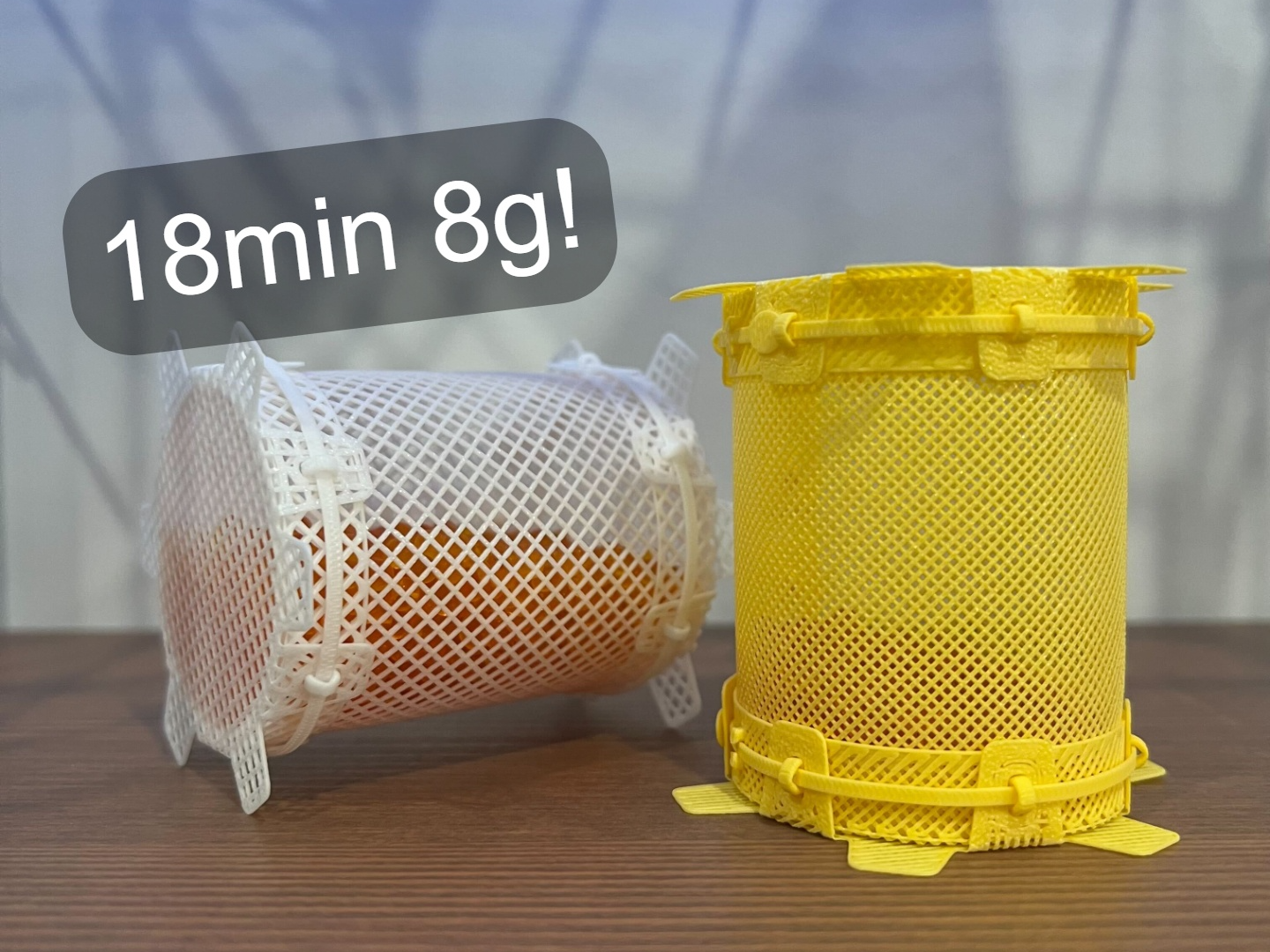
Updates V3 (1/31/2024) The pouch is officially a pouch! By leveraging zero first layer and top layer, this design uses dense sparse infill directly to provide the holes (printing the holes is slow). Super airy, flexible, and yet strong. Low filament cost (~7g) and fast to print (~17 min) too! Slicing Tips: Zero first layer and top layer. Sparse infill: I find Rectilinear works best. Gyroid works too. Grid for example can break easily when squeezed. I default to 65% infill, but you can adjust it to suit your needs. Lids should use 60 degree rotation to maximize hinge crossings. Zipties should have 1 layer top layer, rotated at 90 degree so the top surface has ridges for easier handling. 0.4mm nozzle, 0.8mm line width for sparse infill. (not exactly necessary, but reduces printing time). 3 layer walls for some strength, use Classic generator. Walls must not break the hinges in the first layer. V2 (1/28/2024) Redesigned lid using a buckle + thread approach. Added structural reinforcement on the lids - it is quite difficult to leak any beads now! Reshaped holes to squares that are aligned with infill that shortened printing time. Changed base infill pattern to linear at 30% rotation, which still maintained hinges. Updated profile with increased flow ratio, slightly higher speed, and increased bed temp to 70C (PLA) Cylinder diameter has been shrinked to 48mm to make room for the new lock structures. Description This design features a cylinder shape that is custom fit to the Bambu Spool, and stays inplace using a simple compliant mechanism. This is the second iteration of my previous desiccant box design. You can read more about the design process there. Features Low filament consumption est. 9.5 g Fast print time est. 25 min Flexible arms that hold the box in-place Satisfying assembly process Assembly PDF version available in documentation To disengage the latches: Push below the latch, press down the lid, and then lift the arm. Profile Info Ensure your plate is clean for the default profile. And/or use a higher bed temperature (PLA 65-70 for example). The same rule applies to papercraft prints; infill needs to cross hinges - which is why for the base and cap Octagram Spiral is used. You can go really fast with these low profile prints; I tuned it down a bit due to noise, but you can print it under 20 minutes when cranked to near max speed. Single wall on the first layer. Increased infill/wall overlap for better first layer merging.