About this 3D model
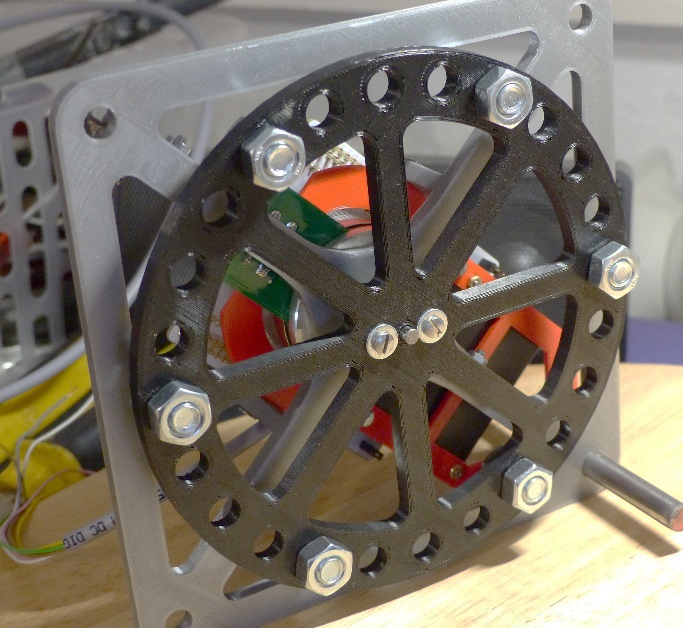
self-balancing frame using reaction wheel "Forces always occur in pairs. If a body A exerts a force on exerts a force on another body B (actio), an equal but opposite force from body B acts on body A (reactio). opposite force from body B acts on body A (reactio)." (Isaac Newton 1687) All the more reason why I have always wondered how satellites in space manage to position themselves without engines in air- and gravity-free space. space without thrusters. Many satellites only have small engines to keep to keep themselves in orbit. However, these are too inaccurate for positioning these are too imprecise. This is precisely the purpose of satellite positioning using flywheels, also known as reaction wheels. This is used for fine alignment of the satellite around its center of gravity axis. The arrangement of several flywheels enables the spacecraft to be positioned around all axes. By combining several systems, this type of stabilization has become established over the years. stabilization over the years. The principle of satellite stabilization using flywheels was used by researchers at ETH Zurich researchers used the principle of satellite stabilization by flywheels for the "Cubli" project to balance a cube on its corner or edge and to erect it independently. By by using three reaction wheels, each controlled by a motor (see Figure 1). (see Figure 1), the cube first stands on an edge and then on one of the corners. on one of the corners. Between the "jumps", the cube stabilizes itself using the flywheels. stabilizes itself with the help of the flywheels. This project work gives engineers an insight into the how satellite stabilization and the Cubli at ETH Zurich work. The model, which is created on the basis of this work, provides the basis for control engineering investigations and further work on this topic.