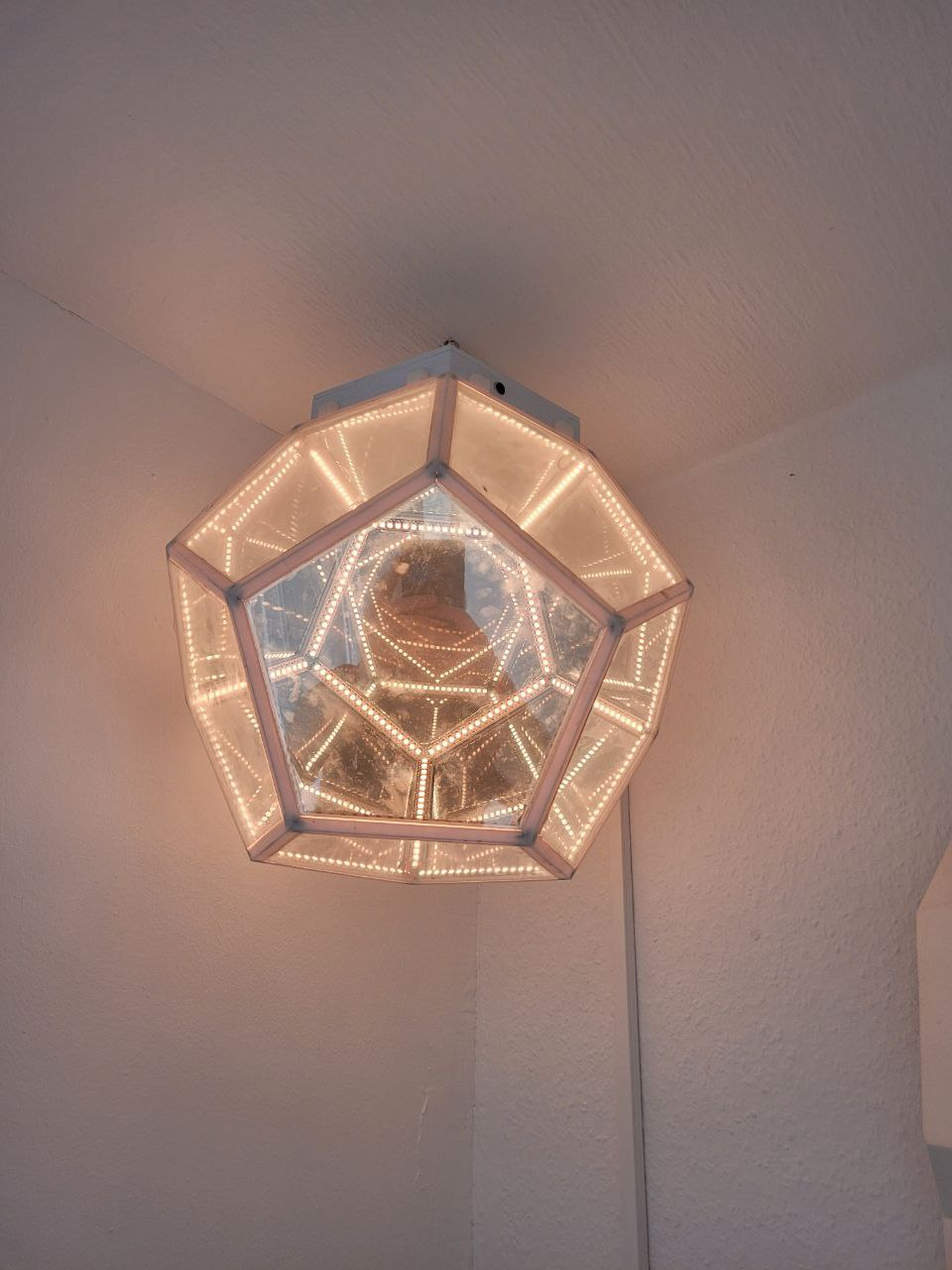
About this 3D model
Build your own infinite dodecahedron lamp. You'll need a few spare hours and around $100-150, no programming skills needed. Here are the parts needed: WS2812B LED strips, 5V. You should aim for at least 144 LEDs/meter ( https://a.co/d/0fUQsES ) ESP32 ( https://a.co/d/bRtiQ4f ), flash WLED on it ( https://kno.wled.ge/ , https://install.wled.me/ ) Mean Well LPV 100-5, a large power supply with ample amperage ( https://a.co/d/bAZd7rE ) Acrylic glass. I ordered pre-cut acrylic glass, thickness: 2mm, radius: 110mm, corners: 5, pieces: 12 One-way mirror window film. Don't opt for the cheapest one - it won't look good ( https://a.co/d/dzpLsOQ ) Threaded rod, diameter: 2mm Superglue, to glue together the border pieces using the threaded rod GY-MAX4466, optional if you want the lamp/LEDs to be audio reactive ( https://a.co/d/cjPirv6 ) Some wires Short instructions: Print parts (30 pieces needed). Cut the threaded rod into 5-7 mm long pieces. Glue these small pieces into the holes (see pictures). Cut the LED strips into small pieces that fit on the inside and glue them to the frame. Apply the one-way mirror film to the acrylic glass. Insert the acrylic glass with some hot glue into the frame (they should fit perfectly). Solder all the LED strips in one long row (see pictures). Flash WLED onto the ESP32 (possible via their website, super easy). Connect the ESP32 to the first LED strip. 9.1 (Optionally) connect the microphone to the ESP32 (see WLED website). Connect power to everything (see WLED website to understand how). Power everything on, connect via Wi-Fi to the hotspot of the ESP32/WLED (again, see WLED docs), and configure the number of LEDs in the Web UI. Get the WLED App, add it to Home Assistant, or do whatever you want with it but have fun.